
On this page
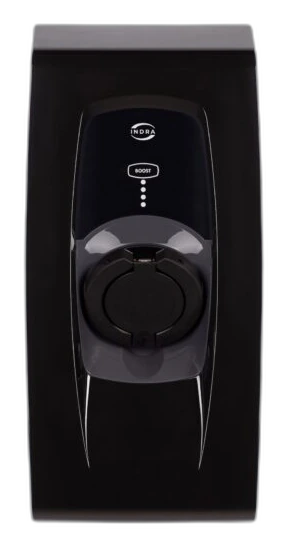
The Indra Smart Pro is a British-made 7.4kW smart home EV charger supplied with standard installation included, combining broad UK tariff compatibility with genuine CT-clamp solar surplus matching. This charging speed can add up to around 30 miles of range per hour for an electric car, making it efficient for daily use. The charger features robust build quality with an IK10 rating, making it resistant to physical impact and durable against accidental knocks and bumps. It suits drivers on a named smart tariff, Intelligent Octopus Go, OVO Charge Anytime, EDF Smart Charging or E.ON Next Drive, and solar households who want their car to charge from surplus without switching charger brands. A Surge Protection Device (SPD) is included as standard, which some rivals charge extra for. The one meaningful caveat: vehicle-to-grid (V2G) and vehicle-to-home (V2H) remain trial-only; buyers who need bidirectional charging today should look elsewhere.
-
Power: 7.4kW single-phase (32A)
-
Cable options: 6m or 10m tethered, or untethered socket
-
Pricing: supplied with standard installation included (verify current pricing at indra.co.uk)
Indra Smart Pro verdict: is it the right charger for you?
Buy it if:
-
You are an EV owner who values flexibility in your home charging solution.
-
You are on or plan to switch to a UK smart EV tariff, Intelligent Octopus Go, OVO Charge Anytime, EDF Smart Charging, or E.ON Next Drive
-
You have solar panels and want surplus-matching charging via a CT clamp without buying a myenergi Zappi
-
You want a British-made product with a 3-year manufacturer warranty
-
You value tariff breadth over design flair
Skip it if:
-
You need full V2G or V2H bidirectional charging today, as Indra’s bidirectional chargers are trial-only and the trials are closed to new applicants
-
You want the absolute cheapest option and are happy with a simpler unit: see the cheapest EV chargers UK guide
-
You want a charger built primarily around Octopus integration; the Ohme ePod is closely coupled to the Octopus API
Key specs at a glance
| Specification | Detail |
|---|---|
| Brand | Indra |
| Power | 7.4kW (single-phase, 32A), typically adds up to around 30 miles of range per hour |
| Connector | Type 2 tethered cable (6m or 10m) or untethered unit with Type 2 socket; untethered allows use of your own charging cable |
| Dimensions | 420 × 200 × 130 mm |
| Weight | 3.5kg |
| Colours | Choice of fascia colours |
| Connectivity | Wi-Fi as standard; Ethernet or 4G (cellular) available at additional cost |
| Protection | IP65, IK10 |
| PEN fault protection | Yes, built in (Indra’s patented PEST technology) |
| SPD | Included as standard |
| Load management | Load curtailment to G100 via external CT clamp |
| Warranty | 3 years |
| OZEV grant | Eligible (flats and rental accommodation) |
| V2G / V2H | Trial only, not a commercial product |
| Pricing | Supplied with standard installation included (verify at indra.co.uk) |
2026 smart tariff compatibility
Indra states its chargers integrate with thousands of UK electricity tariffs, including smart EV tariffs and any time-of-use tariff such as Octopus Agile. In practice, this reflects the charger’s flexible scheduling architecture: the app can work with any tariff that provides an off-peak window or rate schedule, alongside a smaller set of named supplier integrations. For a broader guide to choosing a smart tariff, see our UK EV smart tariff guide.
The key integrations for 2026, as listed by Indra:
| Tariff | Smart Pro integration | Notes |
|---|---|---|
| Intelligent Octopus Go | Yes, supplier integration | Octopus manages dispatch of cheap windows |
| OVO Charge Anytime | Yes, supplier integration | Add-on to a standard OVO tariff |
| EDF Smart Charging | Yes, supplier integration | EDF’s smart charging bolt-on |
| E.ON Next Drive | Yes, supplier integration | E.ON’s smart EV tariff |
| Other time-of-use tariffs | Yes, via in-app scheduling | Includes Octopus Go, Agile and similar tariffs |
Always verify current rates and eligibility on the supplier’s website before switching.
The Intelligent Octopus Go integration is the headline. Octopus manages the dispatch of cheap windows for enrolled chargers; the Smart Pro participates in this ecosystem, so on nights when Octopus extends the cheap window for grid demand management, the Smart Pro can take advantage of the extended off-peak periods.
The ability to set up scheduled charging through the app allows EV drivers to match charging sessions to off-peak windows, maximising savings. You can choose regular slots throughout the week and set how much energy to add by miles, kWh or cost.
Solar diversion and surplus matching
Solar charging is where the Indra Smart Pro differentiates itself most clearly from budget smart chargers. A CT clamp installs at your consumer unit and measures the direction and size of energy flow at the grid connection. The Indra app offers the following modes:
Smart mode: The charger follows the schedule set in the Indra app, or a schedule managed by your energy supplier if you are on a smart EV tariff.
Solar Match: The charger waits for surplus solar to be detected and starts charging automatically when your panels are exporting more than approximately 1.4kW (6A) for at least one minute. Charging matches your excess generation rather than drawing from the grid, which maximises self-consumption on clear, consistent sunny days.
Boost mode: The charger charges at full power, ignoring solar status and overriding any schedule, until the car stops accepting power or you end the session. The physical Boost button on the unit itself triggers this mode, a feature few rivals offer, meaning you do not need to open the app to force a fast charge when you are in a hurry.
The Indra Smart Pro also supports load curtailment to the G100 standard via an external CT clamp, which adjusts the charger’s power draw to protect your home’s main fuse. If the charger loses contact with the CT clamp, it de-rates its output to 6A as a safety measure. This is useful in homes with limited supply capacity or multiple high-load appliances.
For a broader look at solar charging options, see the best solar EV chargers UK comparison. If granular multi-mode solar control is your single biggest priority, also consider the myenergi Zappi; the Smart Pro’s strength is combining solar matching with broad tariff support.
App, scheduling and day-to-day use
The Indra app handles scheduling by tariff window, by manual time window, or by energy added (miles, kWh or cost). The interface is functional rather than polished; it shows you what you need but has fewer interface refinements than the Hypervolt or Ohme apps. Key day-to-day features:
-
Schedule charging by tariff, time window, or energy target
-
Live energy readout in the app
-
Physical Boost button on the unit (not just in the app, a practical advantage)
-
Firmware updates over-the-air
-
Optional Ethernet or 4G connectivity for installations with unreliable or absent Wi-Fi at the driveway
Proper set up of the charger and app is essential for optimal performance. If you experience Wi-Fi connectivity issues at the install location, a Wi-Fi extender can help improve the reliability of the app connection.
The Ethernet and 4G options are rarely offered by competitors at this price point. For driveways remote from the router, the 4G option removes the Wi-Fi coverage issue entirely. Note that Ethernet or 4G connectivity incurs additional cost.
Installation: what the standard price includes
Indra sells the Smart Pro with professional installation included, covering a standard installation by a qualified electrician from its installer network. According to Indra, a standard installation applies to roughly 70% of customers, takes around 2 to 4 hours, and includes:
-
A site survey
-
Wall mounting and connection of the unit
-
Internet connectivity set-up
-
The charging cable on tethered units
If your installation is not standard, Indra quotes the additional work before you commit to buying the charger.
Extras commonly quoted separately by installers:
-
Consumer unit upgrade if the existing board is full or outdated
-
Long cable runs
-
Trenching or surface trunking across hardstanding
-
DNO notification handling if your total load approaches 100A
The OZEV chargepoint grant (75% of the cost, up to £500) applies for eligible residents of flats and rented accommodation; confirm eligibility at gov.uk before purchasing. For a detailed breakdown of what installations cost, see our EV charger installation cost guide.
Indra Smart Pro vs rivals
| Indra Smart Pro | myenergi Zappi | Ohme ePod | Hypervolt Home 3 Pro | |
|---|---|---|---|---|
| Tariff integration | Octopus IG, OVO, EDF, E.ON + any ToU tariff | Octopus Flux native | Octopus IG native | Octopus IG native |
| Solar surplus matching | Yes (Solar Match via CT clamp) | Yes + Eddi surplus diversion | Limited (CT clamp only) | Yes |
| Physical Boost button | Yes | No | No | No |
| V2G | Trial only | No | No | No |
| UK-made | Yes | Yes (Lincolnshire) | UK-designed | UK-designed |
| Pricing | Installation included | Unit + install | Unit only | Unit only |
| Warranty | 3 years | 3 years | 3 years | 3 years |
Smart Pro vs Zappi: If solar self-consumption is the primary driver, the Zappi is a strong choice, particularly when combined with the Eddi hot water diverter. The Smart Pro counters with broader named tariff integrations.
Smart Pro vs Ohme ePod: Ohme has built its product around Octopus Intelligent Go integration. For drivers who exclusively use Octopus IG and have no solar, Ohme is a clean solution. For drivers who want flexibility across multiple tariffs or plan to add solar later, the Smart Pro has the wider base.
Smart Pro vs Hypervolt Home 3 Pro: Hypervolt is often preferred for design and app UX; the Smart Pro counters on tariff breadth and the physical Boost button. Both are well-suited to solar households.
See the full home energy ecosystem comparison for a four-way breakdown.
Pros and cons
Pros:
-
Works with named smart tariffs (Intelligent Octopus Go, OVO Charge Anytime, EDF, E.ON) plus any time-of-use tariff
-
CT-clamp Solar Match mode, genuine solar surplus support
-
Physical Boost button on the unit, useful without the app
-
British-made hardware with optional Ethernet and 4G connectivity
-
IP65 weatherproofing and IK10 impact resistance
-
SPD and PEN fault protection (Indra’s PEST technology) built in
-
3-year manufacturer warranty
Cons:
-
V2G and V2H are trial-only, not a commercial bidirectional product
-
App interface is more basic than the Ohme and Hypervolt apps
-
Larger unit than some compact rivals
-
Wi-Fi is the only standard connectivity; Ethernet and 4G cost extra
-
Load curtailment requires an external CT clamp installation
If the Indra Smart Pro fits your tariff and solar plans, compare it against every UK home charger we track side by side. For solar-specific buyers, also see our best solar EV chargers UK guide.
Useful Resources
OZEV approved chargepoint list
Compare EV tariffs and find the best overnight charging rate for your home.
FAQs
Is the Indra Smart Pro a good charger?
Yes, particularly for tariff-led buyers and solar owners. The combination of broad UK tariff compatibility (including Intelligent Octopus Go integration), CT-clamp solar matching, and British manufacture gives it a strong value case. The main limitation is the trial-only V2G status and an app UX that is less refined than Ohme and Hypervolt.
Does the Indra Smart Pro work with Octopus Intelligent Go?
Yes. The Smart Pro integrates with Intelligent Octopus Go; Octopus controls the charge window and the off-peak rate applies during those windows, including any extended windows Octopus dispatches for grid demand management. The charging speed is up to 7.4kW, and you can monitor and control charging sessions from your phone.
Can the Indra Smart Pro charge from solar panels?
Yes, via an installed CT clamp. Solar Match starts charging automatically when your panels are exporting more than approximately 1.4kW (6A) for at least one minute, so the car charges from excess generation. Boost mode overrides this for a full-power charge. A CT clamp must be fitted at the consumer unit during installation for solar matching to function.
How much does the Indra Smart Pro cost to install in the UK?
Indra quotes a single price including a standard installation, which it says applies to around 70% of customers; non-standard work is quoted before purchase. The OZEV chargepoint grant of up to £500 reduces this for eligible flat and rented accommodation residents. An internet connection (Wi-Fi as standard, or optional Ethernet/4G) is required to access smart features.
Does the Indra Smart Pro support V2G or V2H?
Not as a commercial product. Indra has run V2G and V2H trials, and only trial participants (the trials are closed to new applicants) can currently purchase a bidirectional unit; the Smart Pro itself is a unidirectional charger. Indra says it is developing a bidirectional AC charger compatible with ISO 15118-20. Buyers who need bidirectional charging should verify the current status at indra.co.uk, or consider an alternative product.