
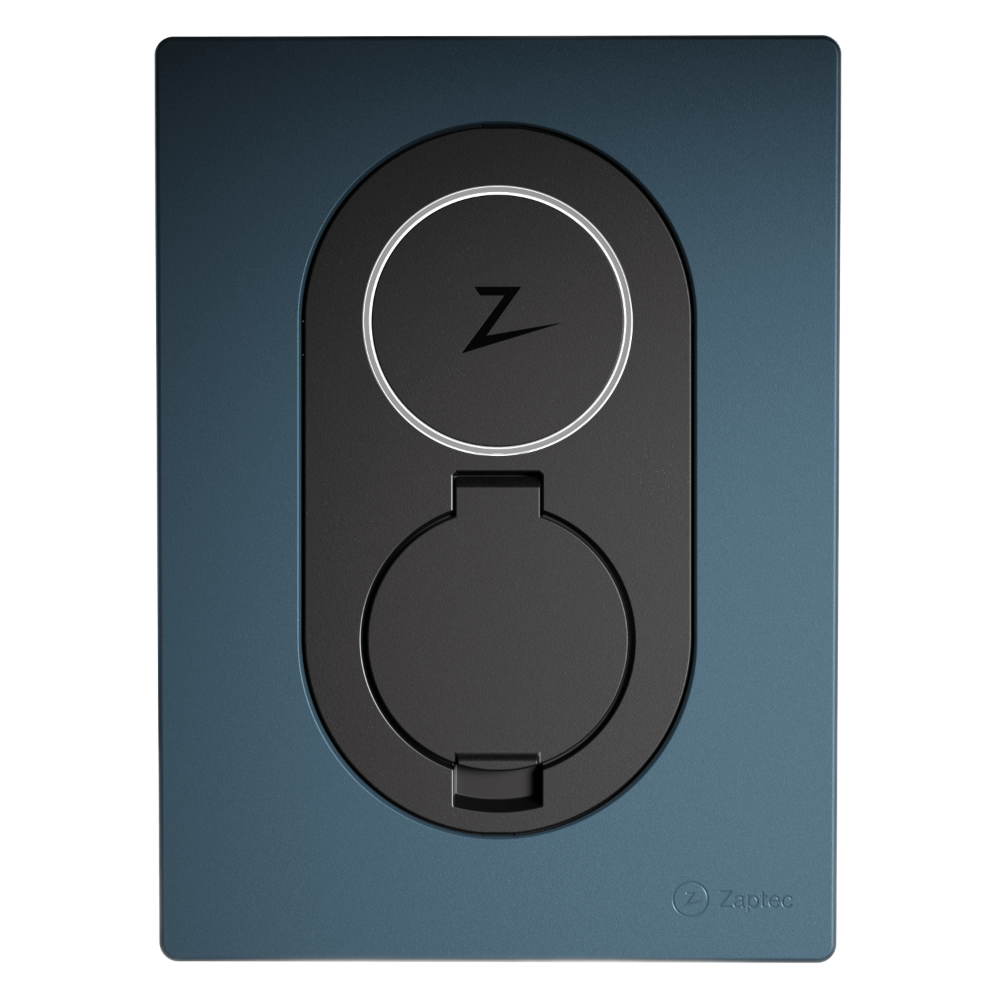
Zaptec Go 2 is a compact charger that incorporates cutting-edge technology and is future-ready, making it ideal for UK drivers seeking a space-saving, advanced EV charging solution. It’s designed for untethered charging, energy monitoring, solar compatibility, and, in its latest form, support for vehicle-to-grid ready hardware, while also featuring built-in 4G LTE and Wi-Fi for reliable connectivity and remote management.
If you’re choosing a home EV charger, the Zaptec Go 2 is worth a look because it is compatible with all types of electric vehicles, including plug-in hybrids, and is suitable for both residential and commercial use. It sits right where everyday home charging meets longer-term energy use. It’s best if you want a compact charger now, but like the idea of moving towards smarter tariffs, solar, and bidirectional charging later.
Key Takeaways
-
Compact untethered charger with strong smart features.
-
Compact charger designed for future-ready energy systems.
-
Compatible with a wide range of electric vehicles, including plug-in hybrids.
-
Built for solar and future energy use, not just basic charging.
-
Stands out if you want flexibility and a premium finish.
Who It Suits and What Sets It Apart
The Zaptec Go 2 is for you if you want a home EV charger that feels modern, compact, and ready for future energy setups. The Zaptec Go 2 is available in six colours, midnight blue, rock grey, wood brown, moss green, asphalt black, and cloud white, allowing you to customize the charger to match your home. Engineered for long-term reliability and compliance with the latest standards, including MID approval for accurate energy metering, it’s aimed at drivers who value smart controls, efficiency, energy efficiency, and being prepared for vehicle-to-grid use.
You’ll probably appreciate it most if you want a charger that can slot into a broader home energy system. If you already care about solar integration, energy monitoring, or you’re intrigued by V2G, this is a good match for sustainable, cost-effective charging. The charger’s minimalist design has drawn positive attention for its aesthetics.
That future-proof angle matters if you plan to keep your charger for years. If your next car or tariff setup changes, the hardware is built to stay useful, and the charger is user-friendly and offers extra features such as remote control and smart integration.
How It Differs From the Original Zaptec Go
Compared with the original Zaptec Go, the Go 2 pushes further into V2G, solar, and smart energy use. It’s not just a small upgrade, it’s a more ambitious home energy device, featuring next-generation grid technology and a MID-approved energy meter for compliance with the Measuring Instruments Directive (MID). The Zaptec Go 2 also comes with a five-year warranty, which is significantly longer than the industry standard of three years for most home EV chargers.
The original Zaptec Go was all about being a strong compact charger. The Go 2 puts more weight behind bi-directional charging, metering, and connectivity, with its MID meter ensuring accurate energy measurement and billing for smart tariffs and future V2G applications. With its Type 2 socket, the Zaptec Go 2 is compatible with all electric vehicles and aligns with the universal standard for AC charging in the UK and Europe.
Where It Sits in the UK Charger Market
In the UK, Zaptec Go 2 sits in the premium smart charger bracket. Among chargers on the market, it’s not the absolute cheapest, but it offers more technical depth and value through advanced features and future-proofing than basic home EV charger models.
Against mainstream rivals, you’ll likely notice its stronger energy and future-readiness story. That makes it appealing if you want flexibility rather than just a plug-in-and-forget unit.
Key Features and Technical Highlights
Zaptec Go 2 is built around a Type 2 socket, smart metering, and connected controls, utilising cutting-edge technology and advanced technology integration for superior charging efficiency and future-proof energy management. Its minimalist Scandinavian aesthetic complements modern homes and workspaces. The Zaptec Go 2 is a home charger designed to be an up-to-date zaptec ev charger and charging station, supporting smart charging and seamless integration with home energy systems.
It’s compact for the set of features it carries, and it’s designed to support both current home charging needs and newer energy systems. The charger is engineered for easy installation and includes earth fault protection for safety and compliance.
Charging Speed
The Go 2 delivers charging power ranging from 1.4 kW (single-phase) up to 22 kW (3-phase), supporting both single-phase and three-phase charging for maximum flexibility. It is designed to automatically switch between single-phase and three-phase charging, optimising power delivery based on your electrical supply. For most UK homes, you’ll get the 7.4 kW figure, pretty much the headline number for domestic use.
That’s a solid overnight charge for most EVs. Actual speed depends on your property’s supply and your car’s onboard charger.
Phase Support and Type 2 Socket Design
You get a Type 2 socket rather than a tethered lead, so you use your own charging cable. The Zaptec Go 2 is an untethered EV charger, requiring a separate charging cable for operation, which enhances flexibility and compatibility. This keeps the unit tidier on the wall and makes it easier to stay flexible if you change vehicles later, supporting a wide range of compatible vehicles from various EV brands and models.
The Zaptec Go 2 supports both single phase connection for typical home installations and three-phase for higher power needs. Phase support is handy, if your supply and vehicle support it, the charger can adapt to different setups without you swapping out the unit.
Energy Monitoring
Energy monitoring is one of Zaptec Go 2’s stronger points. It gives you a clearer view of how much power you’re using, which helps if you want to track costs or match charging to off-peak periods. Accurate billing is ensured through certified metering technology, which is especially important for users on time-of-use tariffs.
If you charge often or use EV tariffs, that’s a big plus. Accurate usage data beats a vague charging estimate every time. In practical terms, this means you can see exactly how much each charging session costs and how much range you’re adding, making it easier to manage your EV charging budget and understand your real energy usage.
MID-Certified Metering and Built-In Display
The MID-certified meter matters if you care about billing accuracy and cost tracking. It ensures compliance with the Measuring Instruments Directive (MID), providing legal and accurate energy readings for trustworthy billing and tariff applications.
The built-in display is handy day-to-day. You can check status at the wall without opening the app, which is great when you just want to see that charging is active.
Connectivity
Built-in 4G LTE, Wi-Fi, and Bluetooth support ensure the Zaptec Go 2 stays reliably connected, even in locations with limited Wi-Fi coverage. The subscription-free 4G connectivity enables dependable remote management, scheduling, and data communication, making it ideal for smart, future-proof EV charging.
This makes setup and remote access easier. A charger that stays online more reliably is just less hassle to live with.
Zaptec App and OCPP 1.6J Support
The Zaptec app lets you control charging sessions, access settings, and track usage, and it includes smart functions for remote control and advanced energy management. It’s your main tool for day-to-day management, especially if you want to schedule charging around cheaper electricity.
OCPP 1.6J support means more flexibility for connected management and third-party compatibility. Handy if you want a charger that can fit into wider energy or fleet systems.
Safety Features Including Integrated RDC-DD
Integrated RDC-DD protection helps detect DC leakage faults, a must-have safety feature in modern EV charging. It can reduce the need for some extra protection measures, depending on your installation.
You still need proper professional installation and the right circuit protection. A strong charger design doesn’t replace good wiring practice.
Weather Resistance
Zaptec Go 2 is built for outdoor use and carries an IP54 protection rating. That’s suitable for typical UK wall-mounted charging, even in exposed spots.
It’s also rated for low and high temperatures. If you’re in a colder or wetter part of the UK, the weather protection is a real strength.
UV Resistant Build and Compact Design
The casing is UV resistant, so it’s better prepared for long-term outdoor exposure. That helps keep the unit looking and performing well over time.
Measuring just 239 mm high and 178 mm wide, the Zaptec Go 2 is one of the most compact chargers available. This compact charger doesn’t dominate the wall, offering a neat, modern look and flexible installation for any home or workplace.
V2G, Solar and Smart Energy Use
Zaptec Go 2 is built with smart energy use in mind, not just basic charging. Its V2G-ready hardware and solar-linked thinking make it more interesting if you want your charger to work as part of a wider home energy plan. The Zaptec Go 2 is the first home EV charger in the UK to support V2G technology, allowing for bi-directional charging and enabling users to benefit from energy market fluctuations.
With Vehicle-to-Grid (V2G) technology, Zaptec Go 2 enables bi-directional energy flow and energy transfer, allowing your EV to act as an energy power bank, transforming your vehicle into a flexible energy storage unit that can support the grid or your home. This vehicle transforming capability means your EV can send stored energy back to the grid during peak demand hours, potentially earning you money or credits from your energy supplier.
V2G technology can help stabilize the National Grid by providing a buffer against the volatility of renewable energy sources, such as wind and solar.
Full V2G functionality will require future software updates and grid certification to activate bi-directional energy flow between your EV and the grid. Smart energy management systems enable automatic charging when electricity prices are lowest, which is crucial for consumers on dynamic pricing tariffs.
What Bi-Directional Charging Means in Practice
Bi-directional charging enables bi-directional energy flow and energy transfer between your EV and your home or the grid. This means your car can both receive power and send it back, allowing your EV to act as a temporary power store for your home or even supply energy to the grid.
It’s a more advanced use case than ordinary charging. Only useful if your car, charger, and energy system all support it.
Vehicle-to-Grid Readiness in the UK Today
Zaptec Go 2 is positioned as V2G ready, which is important, but readiness isn’t the same as full everyday availability. The UK market is still catching up on standards, vehicle support, and energy supplier systems. V2G technology in the UK is still in its early stages and requires compatible vehicles, specific tariffs, and agreements with Distribution Network Operators (DNOs) for full implementation.
Treat V2G support as future-facing rather than immediate for most homes. If you want V2G now, check your car’s compatibility carefully.
Solar Integration and Home Energy Potential
The charger is designed to work with solar integration, supporting solar-optimised charging that enhances energy efficiency by integrating seamlessly with your home solar system. That’s great if you already have PV panels or plan to add them.
Energy monitoring adds value here too. You’ll want good visibility if you’re aiming to line up charging with home solar production.
Limits, Compatibility and Realistic Expectations
Don’t expect full V2G or advanced solar automation to work the same way in every home. Your car, inverter setup, tariff, and installer all affect what’s possible.
Think of Zaptec Go 2 as a capable base for future energy use. That’s safer than assuming every feature will be active right away.
Installation, Compatibility and Running Costs
Zaptec Go 2 installation is straightforward for a qualified electrician, though it still needs proper planning around your property and supply. Installation must meet compliance standards, including regulatory approval for accurate energy metering, and future grid certification may be required to enable advanced V2G features as these become available. Final cost depends on cabling, protection, and whether your home setup is single-phase or three-phase.
What to Expect From EV Charger Installation
A standard EV charger install usually means mounting the unit, running cable, and fitting the right protective devices. You’ll need a suitable location with safe cable routing and good Wi-Fi or 4G coverage, 4G connectivity is especially useful for installations where Wi-Fi coverage is limited, ensuring reliable access to smart features.
In my experience, the smoothest installs are where the home supply is already suitable and the cable run is short. Longer runs or older consumer units can add time and cost.
Single-Phase and Three-Phase Considerations
Most UK homes use single-phase power, so 7.4 kW is the usual practical maximum. If you’ve got three-phase, the Go 2 can support up to 22 kW.
That’s more flexible than many home EV charger options. Still, your car has to accept that higher rate for you to benefit.
OZEV Grant Eligibility and Installer Checks
Check current OZEV grant eligibility before you buy, since rules do change. Grant access usually depends on the charger model, the vehicle, and using an approved installer.
Your installer should confirm circuit protection, earthing, and whether the property needs upgrades. Those checks matter more than the badge on the front.
Tethered vs Untethered Use With a Type 2 Cable
Zaptec Go 2 is untethered, so you’ll need a Type 2 cable to charge. That gives you flexibility, and it can make the charger look neater when not in use.
Untethered setups also work well if you might change cars later. You’re less tied to one cable length or connector.
App Control, Tariffs and Everyday Ownership
The Zaptec app is central to how you use the charger each day. It’s where you schedule sessions, check charging data, and control access without standing at the wall unit. The app helps users optimize charging sessions by scheduling them during off-peak hours to take advantage of the cheapest electricity rates and lower charging costs.
With integrated technology, the app also enables accurate billing and smart energy management. Tariff integration allows users to match charging to favorable electricity rates and prices, and the app tracks each charging session for cost estimation.
Remote control is practical, too. Users can start charging remotely or adjust schedules to avoid peak times and maximize savings.
Scheduling and Remote Control Through the Zaptec App
Scheduling is handy if you charge overnight or want to sync with cheaper rates. You can set charging to start at the right time instead of just plugging in and hoping.
Remote control is practical, too. If you forget to change a setting before heading out, you can still adjust the charger from your phone.
Using Accurate Metering With EV Tariffs
MID-certified metering comes into its own when you want to match charging to a tariff. The MID-approved energy meter ensures compliance with regulatory standards and provides accurate billing for tariff planning. Accurate usage data helps you figure out what your car’s really costing to charge.
That’s especially useful if you’re comparing off-peak pricing. A charger that records usage clearly makes tariff planning a lot easier.
Access Control, Updates and Connected Features
You can use the app to manage who can charge and control access as needed. That’s helpful if the charger is shared by family or installed somewhere guests may park.
The connected setup supports ongoing updates and management. The charger stays up to date with the latest features and security through regular software updates delivered via the Zaptec portal, which also handles user authentication and access control. That gives the charger more staying power than a simple isolated unit.
How It Compares With Other Home Chargers
Zaptec Go 2 stands out through its V2G-ready approach, compact form, and smart energy features. Built with next-generation grid technology, it is a future-ready charger designed for seamless integration with upcoming energy innovations and advanced grid interactions. While the Zaptec Go 2 is designed for home use, the Zaptec Pro is a higher-capacity option suitable for commercial settings or large modern homes, delivering up to 22kW and requiring a three-phase electricity supply.
Its V2G readiness makes it a future-proof investment, justifying its price for buyers seeking long-term technology. Compared to other brands, few chargers on the market offer such a combination of compact design, minimalist setup, and advanced features, making the Zaptec Go 2 a standout choice for daily usability and modern aesthetics.
In the UK, that puts it up against solar-led, tariff-led, and design-led chargers. V2G technology is a game changer for home EV charging, enabling new ways to manage energy and costs.
Against Solar-Focused Alternatives Like Zappi
If solar integration is your main priority, Zappi’s got a strong reputation. It’s built specifically around renewable charging and works well if you already have solar panels.
Zaptec Go 2 is more balanced. Its solar-optimised charging enhances energy efficiency compared to alternatives, supporting solar use while also leaning harder into future grid interaction and connected energy management.
Against Tariff-Led Rivals Such as Indra Smart Pro
Indra Smart Pro is a solid pick if tariff optimisation is your main goal. It’s well known for smart scheduling, tariff support, and sturdy build.
Zaptec Go 2 feels more future-focused on V2G and compact premium design. If you care more about current tariff savings than future charging models, Indra might be the better fit.
Against Compact Premium Options Like Hypervolt
Hypervolt remains a well-known compact premium charger, especially if you value styling, app control, and a neat wall footprint. It’s got a strong day-to-day user experience.
Zaptec Go 2 is one of the most compact chargers available, featuring a minimalist design that fits seamlessly into any modern home or workplace. It competes by offering more advanced energy positioning and V2G readiness. If you want a charger that looks premium and aims further ahead, it’s got a clear case.
Frequently Asked Questions
How much does it cost, including installation?
The charger itself sits in the premium price range, and installation usually adds a few hundred pounds more depending on your property. Your final cost depends on cable length, consumer unit condition, and whether extra protection or upgrades are needed.
What are the key differences compared with the previous model?
The Zaptec Go 2 adds a stronger focus on V2G readiness, solar integration, MID-certified metering, and connected features. It’s built as a more future-facing home EV charger than the original Zaptec Go.
What is the maximum charging power, and can it deliver 22 kW at home?
It can reach up to 22 kW on a suitable three-phase supply. In most UK homes, you’ll usually get up to 7.4 kW because single-phase power is more common.
What are the installation requirements, and do you need a dedicated circuit or PEN fault protection?
You’ll need a professional to install your EV charger on a circuit that’s actually fit for the job, with proper protection devices in place. PEN fault protection and the right wiring setup really come down to your property and what the installer decides after a proper look, don’t just assume your current wiring will cut it.
Does it support vehicle-to-home or vehicle-to-grid functionality?
It’s V2G ready, so it’s built for bi-directional energy flow, allowing power to move both to and from your vehicle, enabling your EV to act as an energy storage source for your home or the grid. Whether you can actually use vehicle-to-grid or vehicle-to-home features depends on your car, your local grid, and how things develop with UK policy and support. Full bi-directional energy flow will require future software updates and grid certification to ensure compatibility with evolving energy networks.
How do you set it up and use the app features such as scheduling, load balancing, and RFID access?
Once you’ve installed the charger, the first thing you’ll want to do is register it in the Zaptec app. That process is pretty straightforward.
Inside the app, you can set up charging schedules, handy if you’re chasing off-peak rates or just want to avoid the evening rush. There’s also a load balancing feature, which is surprisingly useful if your household has a few high-draw appliances running at the same time.
RFID access is built in, so you can decide exactly who gets to charge and when. This is especially helpful if you’re sharing the charger in a communal area or just want to keep tabs on usage.
The app keeps a tidy log of your charging history and energy consumption. It’s honestly kind of satisfying to check in and see how much you’ve saved (or spent).