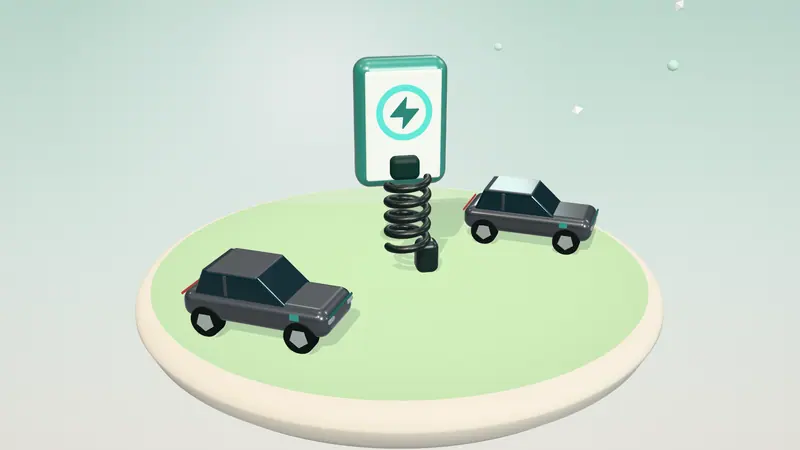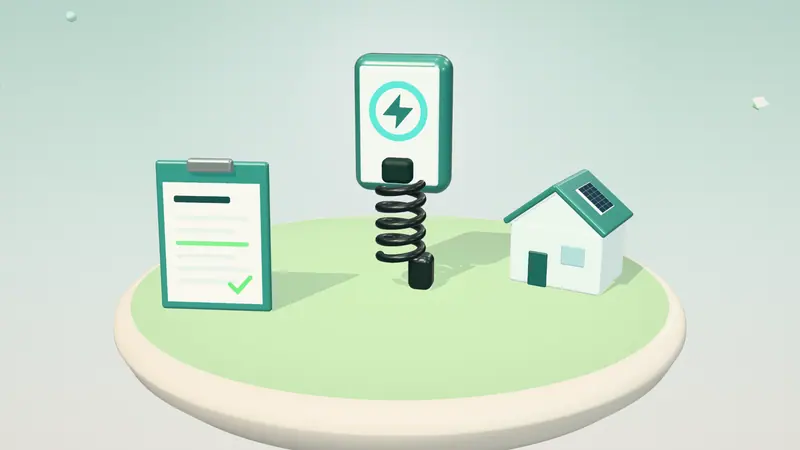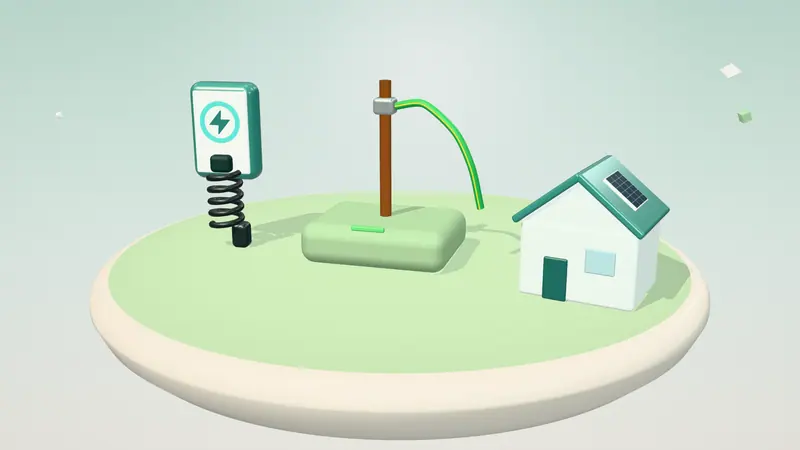
There are five main home EV charging options: a wall-mounted smart charger (usually 7kW, the standard choice with a driveway), a charger on a post where the parking space is away from the house, a 3 pin plug with a portable cable (around 2.3kW, slow but cheap), a three phase charger (up to 22kW, rarely needed) and, for homes without a driveway, a cable channel across the pavement authorised by the council. Laying a cable over the pavement needs the highways authority's consent. Wall and post chargers are permitted development in England within set limits, new chargers must be smart, and OZEV grants of up to £500 run until 31 March 2027 for renters, flat owners and on-street parking homes.
The fastest way to get oriented
For most homes with a driveway, a 7kW smart charger on the house wall. Use a post if the parking space is away from the house, and a cross-pavement cable channel if you park on the street.
Yes, with the portable cable that comes with many cars, but it is slow: around 2.3kW, so roughly 18 hours to add 42kWh before losses. Have an electrician check the socket first.
Not usually in England. Wall and post chargers are permitted development within off-street parking areas and, since 21 October 2026, elsewhere within the curtilage of a house or flats if the conditions are met.
Yes, through a cable channel in the pavement authorised by your council. Cables laid over the pavement need the highways authority's consent.
There are five main home EV charging options in the UK: a charger on your house wall, a charger on a post, a 3 pin plug, a three phase charger and, if you park on the street, a cable that crosses the pavement. Which one suits you depends on where you park, your electricity supply and how far you drive.
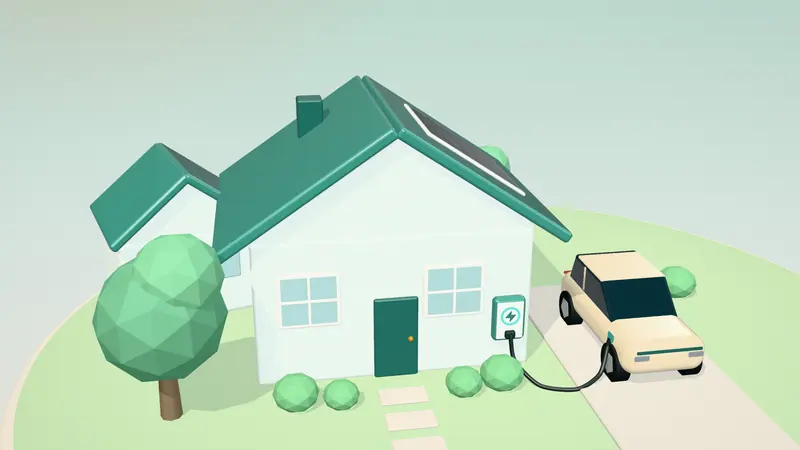
This guide explains how each option works, how fast it charges, what the rules say and which grants apply. Each option has a short 3D animation showing how it sits at a home.
Home EV charging options at a glance
| Option | Typical power | Adds 42kWh in about | Planning permission (England) | Best for |
|---|---|---|---|---|
| Wall-mounted charger | 7.4kW (single phase) | 5 to 6 hours | Permitted development within the rules | Homes with a driveway or garage |
| Charger on a post | 7.4kW (single phase) | 5 to 6 hours | Permitted development within the rules | Parking spaces away from the house wall |
| 3 pin plug and portable cable | About 2.3kW | About 18 hours | Not needed for a socket | Low mileage, plug in hybrids, back-up |
| Three phase charger | Up to 22kW | About 2 hours (if the car accepts 22kW) | As for wall or post chargers | Homes with a three phase supply |
| Cross-pavement cable channel | 7.4kW (single phase) | 5 to 6 hours | Not needed since 21 October 2026, within the rules; council must authorise the channel | Homes with on street parking |
Times are simple arithmetic for adding 42kWh, roughly 10% to 80% of a 60kWh battery, before charging losses. The car’s onboard charger can be the limit, so a car that accepts 11kW on AC will not charge faster on a 22kW charger.
Wall-mounted home EV charger
A wall-mounted charger is the standard home EV charging option. It is fixed to the outside wall of the house or garage, on its own circuit from your consumer unit, and charges the car through a Type 2 connector, the most common type on modern EVs in the UK.
Power and speed
Most home EV chargers run at up to 7.4kW on a single phase supply (32 amps at 230 volts). That is about three times the speed of a 3 pin plug and fills most electric cars overnight.
Tethered or untethered
A tethered charger has its cable fixed to the unit. An untethered charger has a socket, so you plug in your own cable. Tethered is quicker to use day to day; untethered looks tidier and suits a household that may change car. Most smart chargers also come with an app to schedule and monitor charging, and some can charge from spare solar power. Our guide to tethered and untethered chargers compares the models.
Smart charging is the law
Under the Electric Vehicles (Smart Charge Points) Regulations 2021, home chargers sold in Great Britain since 30 June 2022 must have smart functionality. Among other things, each charger must:
- come with pre-set default charging hours outside peak hours, which the regulations define as 8am to 11am and 4pm to 10pm on weekdays, and let you accept, change or remove them;
- start each charge after a random delay of up to 600 seconds, which you can cancel;
- measure the electricity it uses and how long it charges for.
Smart scheduling is also what lets you use a cheap overnight EV tariff. The regulations do not apply to non-smart portable cables, public chargers or rapid chargers.
Installation, earthing and the network operator
A charger needs a new circuit, which is notifiable electrical work, so use a qualified installer who certifies the work. Your installer also notifies your distribution network operator; some homes need the operator’s approval before work starts, for example if the main fuse is too small. Our guide to DNO approval for home chargers covers this.
On many UK homes the supply uses a combined neutral and earth (PME). The wiring regulations require protection against a broken neutral for EV charging on these supplies, provided either by an earth rod or by a charger with built-in PEN fault protection. See do you need an earth rod for an EV charger.
Planning rules
In England a wall-mounted charger is permitted development under Class D of the planning rules, so it needs no planning application if it meets the limits. Since 21 October 2026 those limits include a maximum height of 1.6 metres above the ground. Listed buildings have their own rules, so check first.
Charger on a post
A charger on a post, which the planning rules call an upstand, is the same charger mounted on a pedestal in the ground. It suits a parking space that is away from the house wall, a shared drive, or a front garden.
The supply runs from your consumer unit to the post, usually through a buried duct, so a post installation costs more than a wall charger because of the groundwork. The charging speed and smart rules are the same.
Under Class E of the planning rules, a post-mounted charger is permitted development within an area used for off street parking. Since 21 October 2026 it can also go elsewhere within the curtilage of a house or block of flats, as long as it is the only one, no higher than 1.6 metres in a domestic setting and, for that new part, outside a conservation area.
Charging from a 3 pin plug
You can charge from an ordinary 3 pin plug using a portable cable, often called a granny cable, with a control box in the lead. Many cars come with one, though some newer models are no longer supplied with one as standard.
How fast is a 3 pin plug?
Portable cables usually limit the current to about 10 amps, which is around 2.3kW. Adding 42kWh takes roughly 18 hours before losses, so it suits low mileage, plug in hybrids with small batteries, or emergency top-ups.
Using a 3 pin plug safely
Charging draws close to a socket’s limit for many hours. Have an electrician check the socket and circuit, use a weatherproof outdoor socket, and never use an extension lead or a worn socket. Portable cables are not covered by the smart charge point rules, so they will not schedule themselves for cheap overnight rates unless your car can.
Some portable chargers use a 16 amp commando socket instead, at up to about 3.7kW. That needs its own circuit fitted by an electrician.
Three phase home charging (up to 22kW)
A three phase supply lets a home charger run at up to 22kW. Most UK homes have a single phase supply, and upgrading to three phase is arranged with your network operator and can be expensive.
It only helps if your car’s onboard charger accepts more than 7kW on AC; many cars stop at 11kW. For most drivers, 7kW overnight already covers daily mileage. Our guide to three phase home EV chargers explains when it is worth it.
Charging at home without a driveway
If you park on the street outside your home, there are two ways to get the cable from your charger to your car. Only one is set up for permanent use.
Cross-pavement cable channel
A cross-pavement solution is a cable channel set into the pavement. The cable lies in the channel, usually under a lid, from your property boundary to the kerb. Your charger is on the house wall or a post in the front garden.
Since 21 October 2026, households in England can fit one charger for this without planning permission, under the new permitted development rules. The charger must be no higher than 1.6 metres, outside a conservation area, stick out no more than 0.2 metres from a wall next to the pavement and leave at least 1.5 metres of footway. The cable must use a channel installed or authorised by the highways authority.
The council still decides whether you can have a channel, and the Department for Transport’s guidance says a Section 50 street works licence may be needed. A channel never reserves the parking space outside your home. Our cross-pavement charging news story covers the council side in full.
Cable covers over the pavement
Some drivers lay the cable on top of the pavement under a raised cable cover or mat. The government’s guidance treats these temporary covers separately: they form a small ramp that can lower the trip hazard but do not remove it.
Section 178 of the Highways Act 1980 bars placing any cable over, along or across a highway without the highways authority’s consent, and that includes cables carried overhead. A cover on the surface does not qualify under the new planning rights, which only apply to a pavement-embedded channel. Ask your council before using one.
Other options without a driveway
On street chargers in lamp posts, workplace charging and public hubs are covered in our guide to EV charging without a driveway.
Flats, shared parking and rented homes
If you live in a flat or rent, the charger usually needs the freeholder’s or landlord’s permission. The government opened a consultation, closing on 16 December 2026, on guidance for landlords and on making it harder for landlords and freeholders to refuse reasonable requests.
New homes in England with parking have had to include charging infrastructure since 2022 under Approved Document S of the Building Regulations. A second consultation proposes extending the rules to new and refurbished covered car parks.
If a neighbour has a driveway charger, sharing it can work; see how to share an EV charger with neighbours.
Home EV charging grants
| Grant | Who it is for | Amount | Funded until |
|---|---|---|---|
| Flats and renters grant | Renters and flat owners with private off street parking | Up to £500 per socket (one socket) | 31 March 2027 |
| Households with on-street parking | Owners or renters who only have on street parking, using a cross-pavement solution | Up to £500 | 31 March 2027 |
| Residential landlord grant | Landlords, for their tenants | Up to £500 per socket, up to 200 sockets | 31 March 2027 |
| Workplace Charging Scheme | Businesses and other employers | Up to £500 per socket, up to 40 sockets | 31 March 2027 |
The rates rose from £350 to £500 per socket on 1 April 2026, and the Office for Zero Emission Vehicles describes this as the grants’ final year. Owner-occupiers of houses with a driveway are not eligible for a home charger grant in England. Scotland, Wales and Northern Ireland have their own support; see our OZEV grant guide.
How to choose your home EV charging option
- Check where you park. A drive or garage next to the house points to a wall charger; a space away from the wall to a post; the street outside to a cross-pavement channel.
- Check your mileage. Low mileage or a plug in hybrid may manage on a 3 pin plug; most battery electric cars are better on a 7kW charger.
- Check your supply. Most homes are single phase, so 7kW is the practical maximum without an upgrade.
- Check the rules. Conservation areas, listed buildings, flats and rented homes all need extra permission, and street parking needs the council.
- Check grants and tariffs. Claim a grant through your installer if you are eligible, and move to an EV tariff with a cheap overnight rate.
Away from home, rapid and ultra-rapid public chargers at hubs and motorway service stations top up much faster, but cost more per kWh than charging at home.
Ready to compare chargers? See every home EV charger we cover and find an installer near you.
Correct as of 25 October 2026. Planning rules in Scotland, Wales and Northern Ireland differ from England’s, and council schemes vary, so check locally before you buy.
Key Takeaways
- A wall-mounted 7kW smart charger is the standard home EV charging option for homes with off-street parking.
- A charger on a post does the same job where the parking space is away from the house wall; both are permitted development in England within the rules.
- A 3 pin plug works with a portable cable at around 2.3kW, about a third of a 7kW charger's speed.
- Home chargers sold in Great Britain since 30 June 2022 must be smart, with default charging hours outside 8am to 11am and 4pm to 10pm on weekdays.
- If you park on the street, a council-authorised cable channel is the legal route; covers over the pavement need the highways authority's consent.
- OZEV grants of up to £500 cover renters, flat owners and on-street parking homes until 31 March 2027; owner-occupiers of houses with a driveway are not eligible.
Frequently Asked Questions
How long does it take to charge an electric car at home?
It depends on the charger and the car. Adding 42kWh, about 10% to 80% of a 60kWh battery, takes roughly 18 hours at 2.3kW from a 3 pin plug and under 6 hours at 7.4kW from a wall charger, before charging losses. Your car's onboard charger can also cap the speed, and a bigger battery takes longer to fill from the same charger.
Is a 3 pin plug safe for EV charging?
It can be, using the car maker's portable cable in a socket that an electrician has checked for long, heavy use. Charging draws close to the socket's limit for hours, so extension leads and worn sockets are a fire risk.
Do I need a 22kW home charger?
Usually not. A 22kW charger needs a three phase supply, which most UK homes do not have, and many cars charge at 11kW or less on AC. A 7kW charger fills most cars overnight.
Can I put an EV charger on a post in my front garden?
Yes. In England a charger on a post is permitted development within an area used for off-street parking, and since 21 October 2026 elsewhere in the curtilage of a house, provided it is the only one, no higher than 1.6 metres and, for the new part, outside a conservation area.
Does my network operator need to know about my charger?
Yes. Your installer tells your distribution network operator about a new home charger, and some installations need the operator's approval before work starts, for example where the main fuse is too small for the extra load.
Useful Resources
- The Electric Vehicles (Smart Charge Points) Regulations 2021 · legislation.gov.uk
- The Town and Country Planning (General Permitted Development) (England) (Amendment) (No. 2) Order 2026 · legislation.gov.uk
- Cross-pavement solutions for charging electric vehicles · Department for Transport
- Electric vehicle chargepoint grants · Office for Zero Emission Vehicles
- Changes to electric vehicle chargepoint grant schemes from 1 April 2026 · Office for Zero Emission Vehicles
- Infrastructure for charging electric vehicles: Approved Document S · Ministry of Housing, Communities and Local Government